Five Cheap USB Analyzers, One SPI Bus, and the Glitches That Almost Fooled Us
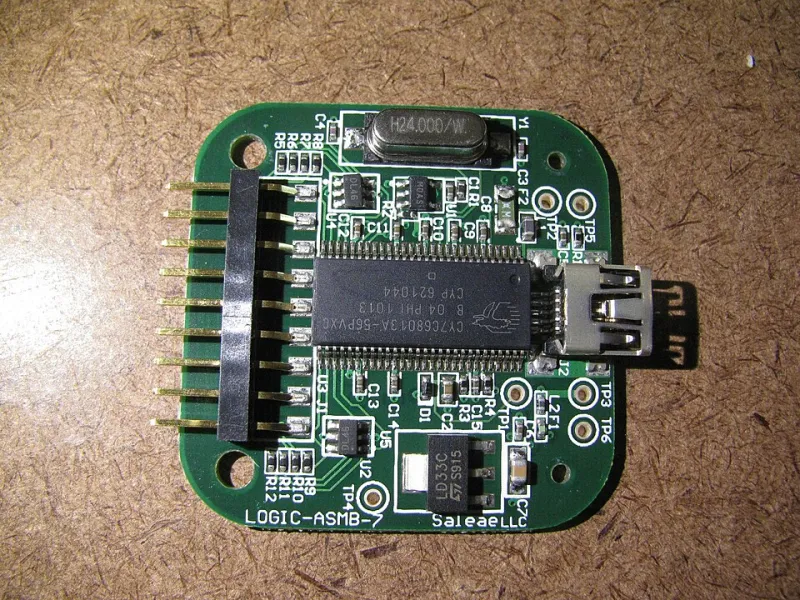
Photo: Myself248, CC BY-SA 2.0, via Wikimedia Commons
The $20 logic analyzer is a miracle of modern commerce. It is also a sampler, and a sampler that lies about time will send you chasing ghosts through firmware that was fine all along. That is the trap with cheap USB analyzers: the software looks confident, the traces look clean, and the numbers on the product page describe a different device than the one in your hand.
We tested five sub-$30 USB logic analyzers against a known-good SPI and I2C bench setup. The goal was not to crown a winner. It was to find the line between useful and misleading, because that line matters more than the price tag.
The bench setup
We used a microcontroller generating SPI at 1 MHz and 8 MHz, mode 0, 8-bit transfers. We also ran I2C at 400 kHz with 4.7 kΩ pullups. To test glitch capture, we injected a 20 ns pulse onto a spare channel. The reference was a 200 MHz bench scope and a lab-grade analyzer, both of which cost more than all five budget units combined.
Every capture used short ground leads. That detail matters. A long ground clip turns a cheap analyzer into a random noise generator with a user interface.
The five units
Unit A was an eight-channel, 24 MS/s design with a plastic case and flying leads. Unit B claimed 24 MS/s but multiplexed channels, so the real rate dropped as we enabled more inputs. Unit C was a 16-channel unit with a 100 MS/s headline and a software package that looked like it was written for a different decade. Unit D was an eight-channel, 24 MS/s pocket unit with probe clips. Unit E claimed 100 MS/s on a few channels and 24 MS/s on the rest.
All five decoded SPI and I2C in software. All five had threshold settings. All five felt like they should be enough for a hobby bus. That last part is where the trouble starts.
SPI at 1 MHz: everyone looks smart
At 1 MHz, all five units produced decodable SPI traces. The clock and data lines were clean enough, the decoders agreed on the bytes, and the experience was pleasant. Unit A and Unit D were the easiest to set up. Unit C had the most features and the most confusing menus. Unit B was fine until we enabled more than four channels, at which point the effective sample rate fell and the trace got chunky.
This is the zone where a $20 analyzer is a genuinely good tool. If you are bringing up a sensor, checking a chip select, or verifying that a microcontroller is actually sending the bytes you think it is, these units earn their keep. You do not need a $1,000 instrument to see that MOSI is idle when it should be busy.
SPI at 8 MHz: the wheels come off
At 8 MHz, the sample rate stops being a spec sheet bragging point and starts being the whole story. A 24 MS/s analyzer gives you three samples per bit. That is enough to guess, not enough to trust. Unit B produced a trace that looked plausible and decoded two bytes wrong. Unit D showed false edges on the clock line that vanished when we shortened the ground lead. Unit A hung on longer than expected but still blurred the last bits of each transfer.
Unit C and Unit E, the two with higher headline rates, did better. Unit C caught the 8 MHz bus cleanly once we accepted that only four channels ran at the full rate. Unit E was fast on two channels and noticeably slower when we enabled the rest. Neither was as clean as the bench scope, but both were honest enough to debug with.
The lesson is not that cheap analyzers are junk. It is that the sample rate per active channel is the number that matters, and the marketing copy rarely puts it in the same sentence as the price.
I2C, glitches, and the ground lead trap
I2C at 400 kHz was easy for every unit. The bus is slow, the edges are soft, and the protocol decoder has plenty of time. If I2C is your main job, almost any of these analyzers will do.
Glitch capture separated the field. A 20 ns pulse is less than half a sample at 24 MS/s. The four 24 MS/s units missed it completely. Unit C caught it once in five attempts, and only when we used the shortest ground lead and a stable trigger. That is not a guarantee; it is a warning. If you are hunting short spikes, a budget analyzer is the wrong instrument.
The other trap is the ground lead. A long clip adds inductance and turns fast edges into ringing. We watched one unit report a clean SPI bus with a long ground lead and a distorted one with a short lead. The analyzer was not lying. It was measuring the loop we gave it.
When a $20 analyzer is the right tool
Use a cheap USB analyzer for low-speed digital buses, pin-state checks, protocol decoding, and the first pass on a new board. Use it when you need to know whether a signal is toggling, not whether it is clean. Use it when the alternative is guessing.
Step up when you need to trust timing at 8 MHz and above, when you are hunting glitches shorter than a microsecond, when you need analog information, or when you need long captures across many channels. At that point, a bench scope or a better analyzer is not a luxury. It is the difference between debugging and story time.
The $20 logic analyzer is not a toy. It is a limited instrument with a confident interface. Treat it like a cheap multimeter: useful, honest within its range, and dangerous if you forget where the range ends.