Print It or Buy It: We Stress-Tested a $300 Printer Against 20 Everyday Workshop Items
Every maker has that moment: you're elbow-deep in a project at 9 PM, you need one more hold-down clamp, and the closest Lowe's closes in an hour. The 3D printing evangelists say the answer is simple — print it. The skeptics say a $300 printer is a very slow, very loud plastic toy. We decided to settle it with a stress test.
The Setup: One Cheap Printer, Three Weeks, Twenty Items
We grabbed a $300-class FDM printer (the kind on every holiday gift guide), stocked up on PLA, PETG, and a spool of ABS, and made a list of the 20 items we buy most often at the hardware store: clamps, corner braces, drill guides, sanding blocks, bit organizers, wrench holders, solder spool stands, cable combs, and the like.
For each item, we asked three questions. Can it be printed? Does it survive real use? And — the one nobody talks about — is it actually cheaper once you count failed prints, filament, and electricity?
Where Printing Wins, Decisively
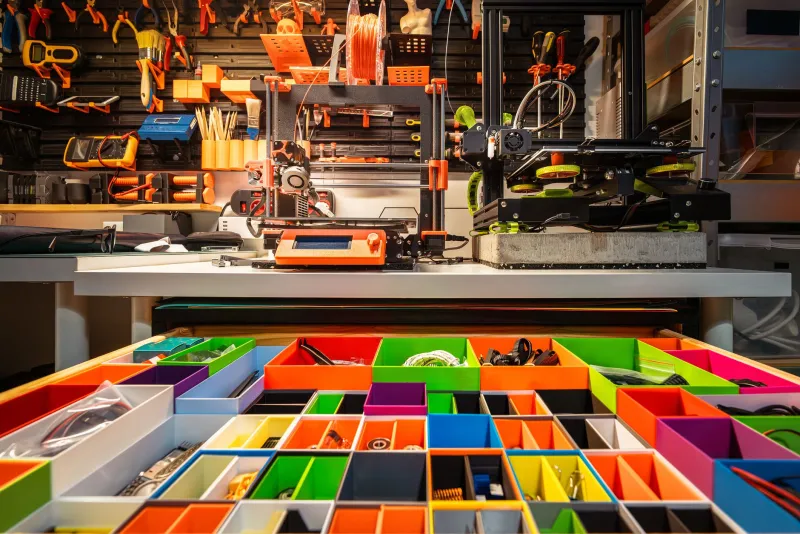
Organizational stuff is a slam dunk. Bin systems, socket trays, drawer dividers, solder spool racks — these are the reasons gridfinity-style storage took over every maker's workbench. A store-bought stackable bin runs $3 to $6. The printed version costs about 40 cents in PETG and fits your actual drawer, not some big-box standard.
Jigs and drill guides are the second win. A $12 aluminum drill guide block does one hole spacing. A printed jig takes 15 minutes of design time and can be regenerated for every spacing you'll ever need. We built a doweling jig for a bookshelf project that would've cost $30 retail — ours cost under a dollar in filament and worked flawlessly.
And then there's the stuff that simply doesn't exist in stores. The bracket that mounts your fume extractor to a specific extrusion at a weird 67-degree angle? Nobody sells that. Printing is the only option, and it's a great one.
Where It Fails Spectacularly
Clamps were our humbling moment. We printed a popular F-clamp design in PETG at 40% infill, and it held firm right up until we cranked it on a hardwood glue-up. The fixed jaw snapped with a sound like a knuckle cracking. PLA was worse. If a clamp is holding glue under real pressure, buy the clamp. The $8 Irwin you can grab at Home Depot will outlive every printed clone you make this decade.
Anything with a hammer involved is also a no. Mallets, pry bars, chisel handles that take impact — FDM parts are built up in layers, and those layers are where cracks start. A printed mallet head survived exactly eleven strikes on a bench dog before delaminating.
Threaded load paths are borderline. Printed threads in PETG handle a few light-duty assemblies fine — camera mounts, enclosure lids. But we stripped a printed M8 thread on the third torque cycle. Heat-set brass inserts are the fix, and once you add those, the 'free part' math gets shakier.
The Cost Breakdown, No Rose-Colored Glasses
Here's the honest ledger across our 20 items, counting filament at $20/kg, electricity at the US average of about 17 cents per kWh, and a 15% failure/reprint rate:
- Storage and organization (8 items): ~$4 printed vs. ~$34 bought. Print it, always.
- Jigs, guides, and templates (5 items): ~$6 printed vs. ~$52 bought. Print it.
- Light-duty clamps and hold-downs (3 items): ~$5 printed vs. ~$21 bought — but one failure mid-project erases the savings. Buy the ones that matter.
- Impact and load-bearing tools (4 items): Printed versions failed or underperformed every time. Buy.
Net result: roughly $15 in material replaced about $107 in store-bought goods, with the caveats above. Your time is the hidden variable — a four-hour print for a $2 bin only makes sense if the printer runs while you're doing something else.
The Materials Cheat Sheet for Load-Bearing Prints
- PLA: Rigid, dimensionally accurate, but softens near 60°C — the inside of a hot car or a sunny garage in Texas will warp it. Great for jigs, terrible for engine bays.
- PETG: The workhorse. Slightly flexible, survives drops, handles 80°C. Your default for anything with a bolt through it.
- ABS/ASA: Tough and heat-resistant, but needs an enclosure and patience. Worth it for anything living in a garage or under a car hood.
- CF-filled nylon: Genuinely strong, genuinely finicky, and genuinely expensive at $40+ per spool. Reserve it for parts that would otherwise be machined.
Whatever you pick, orient layers so force presses parts together, not peels them apart. Wall count matters more than infill — four perimeters will do more for strength than 60% infill ever will.
The Verdict
A $300 printer won't replace your hardware store, and anyone telling you otherwise is selling filament. But it will replace about half of your hardware store runs — the bins, the jigs, the one-off brackets, the 'I just need something that fits exactly here' moments. Keep the clamp aisle on speed dial. Everything else? Hit print before you grab the car keys.