Race Against the Freight: We Made the Same PCB Three Ways at Home and One Way in Shenzhen
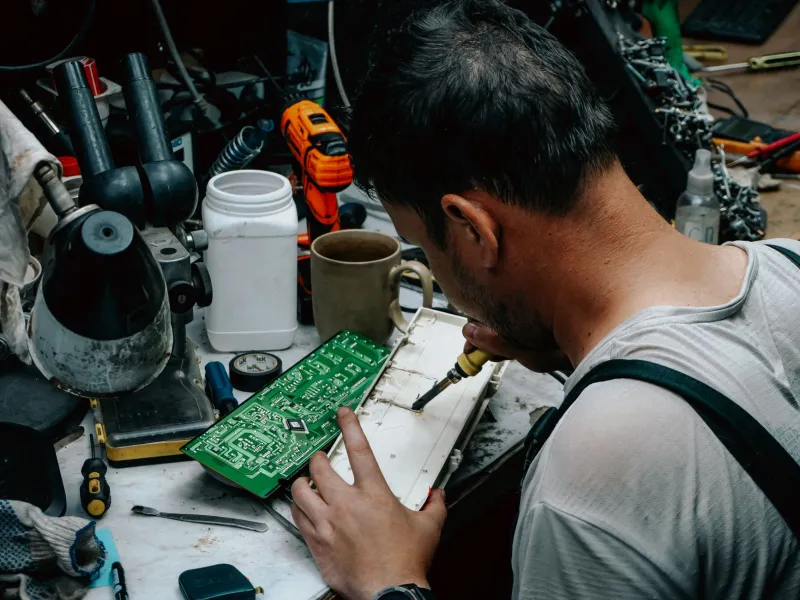
There's a certain romance to etching a circuit board in your garage. It's the maker equivalent of churning your own butter — inefficient, slightly messy, and deeply satisfying. But romance doesn't solder components. So we decided to settle the question every hobbyist eventually asks: can you actually get a working PCB faster by making it yourself than by ordering one?
We picked a simple-but-not-trivial test board: a two-layer design with a 555 timer, some passives, a few 0.5mm-pitch traces, and a ground pour. Nothing exotic, but enough complexity to separate the contenders. Then we ran it through four pipelines: toner transfer with ferric chloride, a $350 desktop CNC mill, a UV exposure box we built from a salvaged scanner, and — as the control group — a cheap rapid-fab service in China that rhymes with "JLC." Every step got timed. Every failed attempt got billed.
Contender One: Toner Transfer, the People's Method
Total material cost for the board itself: about $1.75 in copper-clad laminate, toner, and etchant. Sounds great until you account for the two boards we ruined learning that our laser printer toner is, apparently, 40% magic and 60% disappointment.
Time to first working board: 4 hours 20 minutes, spread across three attempts. The transfer iron dance is finicky — too much pressure and the traces smear, too little and they lift. The etch itself took just 12 minutes in a warm ferric chloride bath, which was genuinely faster than we expected. Drilling, though. Drilling took 45 minutes with a pin vise and made us question our life choices.
The verdict on quality: traces down to about 8 mil worked. Our 0.5mm-pitch pads did not. If your project is DIP packages and through-hole parts, this method is cheap, fast, and honestly kind of fun. If it's a modern IC, look elsewhere.
Contender Two: The CNC Mill — Precision at a Price
Our desktop router chewed through isolation routing in 38 minutes, and the first board came out functional. That's the good news. The bad news: setup took another 40 minutes, bed leveling ate 15 more, and we snapped a $4 carbide bit on board two when we got greedy with feed rates.
The real cost per board, amortizing the machine over a generous 50 boards, is north of $12 each before consumables. But the workflow is legitimately beautiful — no chemicals, no darkroom, and the machine handles your drill holes automatically. For one-off boards with fine features, this was the fastest home method end to end: 2 hours 10 minutes from Gerber to drilled, functional board.
Contender Three: The UV Exposure Box
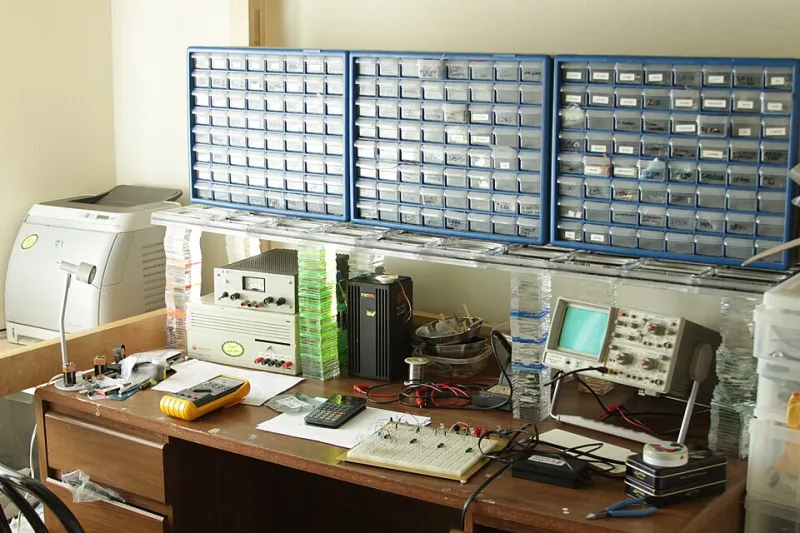
We built the exposure box from a salvaged flatbed scanner for about $60, which felt very on-brand for this site. The photoresist process gives you the best trace fidelity of any home method — we cleanly resolved 6 mil traces. But the pipeline is long: print transparency, expose 8 minutes, develop, etch, strip, drill. Total time: 3 hours 15 minutes, plus the failed first attempt when we discovered our transparency printer prints transparencies... mostly.
Contender Four: The Shenzhen Express Lane
The fab service quoted $2 for five boards plus $14 shipping. We uploaded Gerbers on a Tuesday at 9 AM. Boards arrived the following Monday — 5 days, 14 hours door to door. Quality was flawless: solder mask, silkscreen, plated vias, the works. Cost per board after tariffs-free shipping math: about $3.20.
Here's the thing the DIY community doesn't say out loud enough: if your timeline is measured in days anyway, the Chinese fab wins on every axis except the waiting. You cannot beat $3.20 for a professional board. You can only beat the clock.
So When Does the Garage Actually Win?
Add it up, and the math is clearer than we expected:
- Need it in the next 4 hours? CNC milling wins, and it's not close.
- Board is through-hole and simple? Toner transfer costs pocket change and takes an afternoon.
- Need fine pitch and professionalism? Order from China. Always. Even with the wait.
- Weekend project for the joy of it? All three home methods deliver, and the skills compound.
The real insight isn't speed or cost — it's iteration shape. Home fabrication gives you a tight loop: tweak, cut, test, repeat, all in one session. The fab service gives you a better product but forces a week-long pause in your momentum. We found ourselves designing more carefully for the Shenzhen boards and more recklessly for the garage ones, and honestly, the reckless designs taught us more.
Our final tally, failures included: toner transfer cost us $8.75 and 4.3 hours per working board; CNC, $13.40 and 2.2 hours; UV, $4.10 and 4.9 hours; Shenzhen, $3.20 and 134 hours. The garage doesn't beat the freight in dollars or the calendar. But for the three hours on a Saturday when you need one more board right now, nothing ships faster than your own basement.
And that, fellow makers, is a kind of speed no logistics network can sell you.