The Budget Bench: Free Software That Puts Pro Test Gear Within Reach
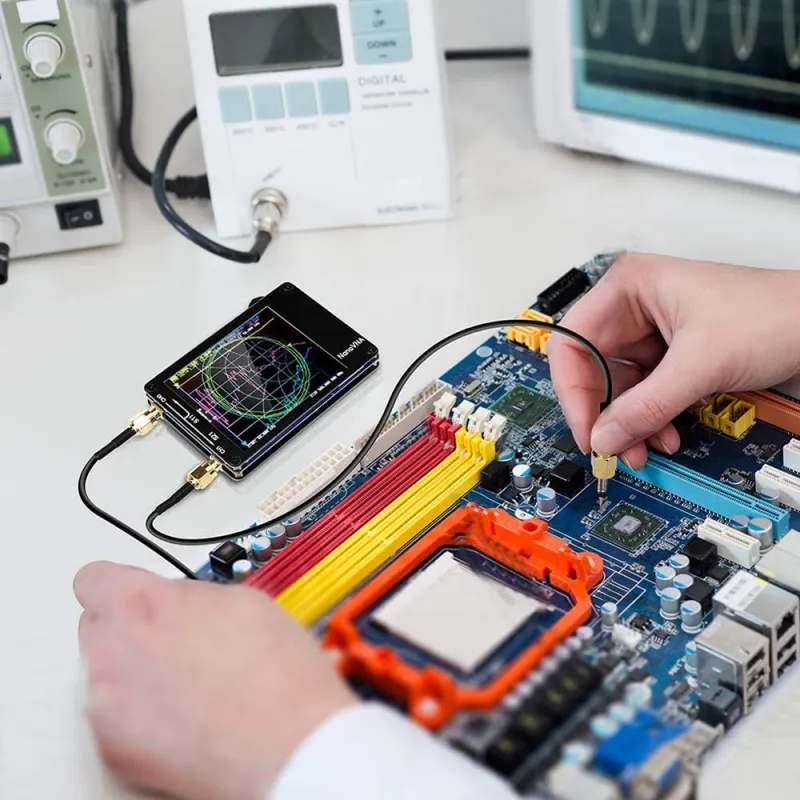
Photo: electronics workbench logic analyzer NanoVNA budget test equipment, via down-my.img.susercontent.com
Every maker hits the same wall eventually: you need to debug a protocol, characterize a filter, or sweep an antenna, and the instrument that does it costs more than your car. But over the last few years, a quiet revolution has happened in free software — tools that, paired with cheap hardware, genuinely rival gear that used to be locked behind lab budgets. We put the leading contenders through real projects to find out which ones earn bench space.
The Heavy Hitters
Sigrok/PulseView + a $10 Logic Clone
The single best value in all of test equipment might be the combination of the open-source Sigrok stack with one of the ubiquitous 24 MHz, 8-channel USB logic analyzer clones. PulseView, the graphical frontend, decodes dozens of protocols — I2C, SPI, UART, CAN, even infrared — for free, with a decoder framework that's extensible in Python.
In our testing, it handled a 400 kHz I2C bus capture with protocol decode flawlessly. Where it stumbles: the cheap clone hardware tops out around 16 MHz sampling in practice, and the sample memory is shallow. You're not capturing long bus traces at high speed. But for the vast majority of embedded debugging, this pairing does 90% of what a standalone logic analyzer does, at 2% of the price.
NanoVNA and Its Ecosystem
The NanoVNA phenomenon deserves its reputation. A two-port vector network analyzer for under $60, covering roughly 50 kHz to 900 MHz (the V2 variants push to 4+ GHz with caveats), transforms antenna work and filter characterization for ham operators and makers alike.
The stock firmware is serviceable, but the community-developed alternatives — like NanoVNA-Saver on the PC side — add calibration files, sweep averaging, and proper Smith chart displays. We used it to tune a 433 MHz whip antenna and characterize homemade low-pass filters, and the results tracked our expectations within a couple of dB. Accuracy at the top of its range gets shaky, and dynamic range is nowhere near a $10k bench VNA. But for antenna trimming? It's not a toy. It's the real thing.
SDR Software: The Free Spectrum Analyzer
We've covered RTL-SDR dongles before, but the software ecosystem around them keeps getting better. SDR# with the appropriate plugins, or the cross-platform SDRAngel, can act as a crude spectrum analyzer with peak hold. For EMC sniffing with near-field probes, it's remarkably effective. The limitation is real, though: 8-bit ADC samples mean limited dynamic range, so don't expect to see a weak signal next to a strong one.
LTspice and KiSim
Circuit simulation might be the most underused free tool in the maker world. LTspice, free from Analog Devices, remains the gold standard for switching regulator and analog simulation — we've caught a mis-sized compensation network in a boost converter design before it ever hit a PCB. Pair it with the growing library of third-party component models and you can prototype half your power section in software.
The Honorable Mentions
PulseView's cousin, sigrok-cli, makes automated captures scriptable — great for regression-testing a firmware change against known-good bus behavior.
OpenHantek breathes life into the cheap Hantek DSO dongles, turning a $40 USB oscilloscope stick into something usable, if modest.
Qucs-S is maturing into a genuinely useful RF and circuit simulator, bridging some gaps LTspice leaves open.
The Two That Overpromise
Not everything in the free-instrument world holds up under real workloads, and we'd be doing you a disservice not to name names.
Free 'PC oscilloscope' suites bundled with sound card interfaces. The idea — use your audio input as a scope — is seductive, and the software is often polished. But your sound card is AC-coupled, band-limited to well under 100 kHz, and utterly unprotected against the 12 V you will eventually, inevitably connect to it. We cooked a USB audio interface in ten minutes. As an educational toy, fine. As an instrument, it's a trap.
Browser-based 'VNA' and analyzer web apps. Several promise full instrument functionality from a webpage connected to a hobby board. In our testing, latency made interactive tuning miserable, browser updates broke the serial drivers mid-project, and calibration data wouldn't persist. The desktop-native tools do the same jobs better. Skip the browser layer.
What This All Means for Your Bench
Here's our honest ranking of what this software ecosystem can and can't replace:
Fully replaced for most makers: the low-end logic analyzer, the antenna analyzer, the basic spectrum sniffing setup, and a surprising amount of simulation work.
Partially replaced: the oscilloscope. Free software plus cheap capture hardware gets you there for slow, repetitive signals — but nothing free yet matches a real scope's front end, memory depth, and trigger engine for gnarly single-shot events.
Not replaced: calibrated, traceable measurements. If you're certifying a product or doing precision metrology, freeware tools are for troubleshooting, not sign-off.
The takeaway? A complete, capable electronics lab — logic analysis, RF characterization, simulation, spectrum sniffing — now runs about $150 in hardware plus zero dollars in software. That's not a compromise anymore. That's the new baseline, and the big instrument makers know it.